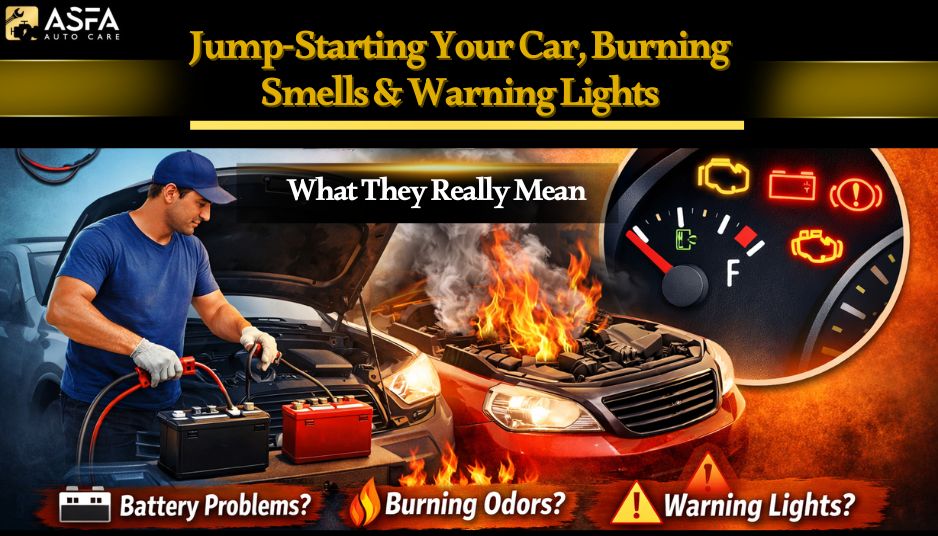
Your car tells you that something is wrong, either through a flat battery, a weird burning odour, or a sudden warning light on your dashboard. It is only when you understand these car warning signs that you will be able to prevent expensive repairs, unsafe driving, and other unpredictable malfunctions.
Today, we will discuss with you everything you need to know about the most common warning signs, what they mean, and how you can prevent your car from breaking down.
Why Cars Give Warning Signs Before They Fail
Modern cars are made in such a way that they alert the drivers before any serious damage happens. The engine, battery, brakes, and electrical system are always monitored by sensors. When there is something wrong, the car notifies you through warning lights, smell, or a change in performance. When one ignores the car warning signs, a minor problem can become a very costly fix.
Jump-Starting Your Car: What It Really Tells You
The fact that one needs a jump-start is never a one-off problem but a deeper one. Knowing the reason why your car could not start helps you decide what your next steps should be.
When a Jump-Start Is Usually Not a Big Problem
A jump-start usually is harmless when:
- Lights or accessories were left on
- The vehicle was not used for some days.
- The cold weather decreased the power of batteries.
- The battery is relatively new.
In such instances, the problem could be solved by merely recharging the battery, after which the problem might not occur again in the near future.
When a Jump-Start Is a Warning Sign
Jump-starts, when repeated, mean that there is some underlying issue, more than just car battery problems. Common causes include:
- An ageing or worn-out battery
- The battery terminals are loose or rusted.
- A failing alternator
- Electrical drains that continue to consume electricity even after turning off the car.
When it turns out that your vehicle requires regular jump-starts, it is not a coincidence anymore.
How Jump-Starting Affects the Alternator
The alternator works more than usual to fill up the flat battery after a jump-start. This additional load may overheat the alternator if it is already weak. The heat could result in a burning smell, a warning light or even full alternator failure in the near future. This is why a jump-start can sometimes be followed by new problems.
Burning Smells From Your Car and What They Mean
Burning odours are among the most alarming car warning signs for drivers. The type of smell usually serves as an indication of the cause.
Burning Plastic Smell
Your car smells like burning plastic because:
- The exhaust had plastic bags stuck to it.
- Melted wire insulation
- Electrical parts are overheated.
Melting plastic bags on the exhaust is very common; they are usually harmless when removed. Nevertheless, incineration of electrical insulation is even more severe and must be checked quickly.
Burning Rubber Smell
If your car smells like burning rubber, it is often caused by:
- Slipping or worn drive belts
- Misaligned pulleys
- Overheated hoses
Slipped belts cause friction and heat. The belt may also break off, leaving you stranded in the middle of nowhere if you ignore it.
Burning Oil Smell
An oil smell often means:
- Leakage of oil to the hot part of your car’s engine.
- Worn gaskets or seals
- Overfilled engine oil
The burning of oil on hot surfaces generates a strong smell and smoke. Small leaks might not necessarily stop the car, but should be fixed to prevent damage to the engine.
Electrical Burning Smell (Urgent)
One of the most dangerous warning signs is an electrical burning smell from the car. It can be caused by:
- Overheated wiring of the alternator
- Short circuits
- Failing starter motor
- Damaged electrical cables
You must pull over and have the vehicle checked immediately if you get the smell of burning electronics.
Why You Should Never Ignore Dashboard Warning Lights Explained
These are the most clear indicators of your car’s problems. Some permit limited driving while others require immediate intervention.
Battery Warning Light On
A battery light does not necessarily indicate that the battery is faulty. A car warning lights meaning:
- Alternator problems
- Loose or damaged wiring
- Charging system failure
-
-
-
When this light is on while driving, it means that the battery is not charging well. If you do not get your car checked by a car services Adelaide specialist, it can come to a stop unexpectedly, leaving you stranded in the middle of nowhere.
Check Engine Light
A check engine light can indicate a lot of things, some of them are:
- Loose fuel cap
- Sensor malfunction
- Engine misfire
- Emissions problems
Solid light generally indicates that it is possible to drive the car carefully. An urgent problem is indicated by a flashing light, which can harm the engine.
Oil Pressure Warning Light
This light means:
- Low oil level
- Oil pump failure
- Loss of oil pressure
Low oil pressure driving may ruin the engine in just a few minutes. In case this light comes on, switch off the engine.
How Jump-Starting, Smells, and Warning Lights Are Connected
Most drivers are not aware that these issues are closely interconnected. A single problem may cause a number of problems.
The Alternator Chain Reaction
A weak alternator can cause:
- The battery drains quickly
- The battery warning light comes on.
- Burning electrical smells
- Dashboard lights keep flickering.
- Poor engine performance
This is a boomerang phenomenon that most of the time begins with a jump-start and ends in a breakdown when left unattended.
Electrical Overload Problems
Electrical systems become hot when they are overworked. Heat destroys wiring, sensors and connectors, leading to signs of car electrical problems and other problems. This results in smells, warning lights, and system failures that would seem to have no connection with one another on the surface, but they all have one cause.
Preventing These Problems in the Future
With just basic maintenance practices, you can avoid such issues. Some of them are:
- Drive your car regularly
- Avoid repeated jump-starting
- Turn off lights and accessories before switching off the engine
- Get the battery tested every year
- Keep battery terminals clean and tight
- Pay attention to new smells immediately
- Do not ignore car safety warning signs
- Check fluid levels regularly
- Avoid overloading the electrical system
- Schedule routine servicing
Conclusion
Jump starting, burning smells, and warning lights do not start without a reason. It is important to understand the meanings of these signs to take the appropriate action before being on the wrong side of a car failure. Also, it is good to have your car checked by mechanical repair services instead of letting it malfunction.
Read Also: How Do I Know If My Car Battery Is Dead?